Cicero Historical Society
Student Essay Contest
$250 prizes · Entries
Nov 1–30
November 1–30, 2026
Learn more →
John Leach makes the first settlement at Cicero Corners, 1802.
Simon Le Moyne records a visit to Techiroguen, the Onondaga fishing village at the outlet of Oneida Lake, 1654.
Cicero is laid out as Township No. 6 of the Military Tract, 1790.
The Town of Cicero is set off from Lysander, 1807.
The western half of Cicero becomes the Town of Clay, 1827.
Elijah Loomis and Martin Woodruff settle at South Bay, 1804.
A ferry is authorized across the outlet of Oneida Lake, 1813.
District No. 1 schoolhouse built — the town's first district school, 1824.
Stone Arabia Schoolhouse built, 1854.
The Stone Arabia School is listed on the National Register of Historic Places, 2007.
Cicero Union School built at the Four Corners, 1867.
The trolley line to South Bay is built, 1909.
The Erie Canal opens, October 26, 1825.
John Forbes Benjamin, later a general and a congressman from Missouri, is born in Cicero, January 23, 1817.
Cyrus Kinne Porter, later a Buffalo architect, is born in Cicero, August 27, 1828.
Adelbert N. Everson, later awarded the Medal of Honor, is born in Cicero, April 12, 1841.
Willis Edgar Heaton, later a judge and a delegate to the 1915 Constitutional Convention, is born in Cicero, September 15, 1861.
Dave Giusti, later a North Syracuse High School and major-league pitcher, is born in Seneca Falls, November 27, 1939.
Patrick Corbin, later a Cicero–North Syracuse and major-league pitcher, is born in Clay, July 19, 1989.
Breanna Stewart, later of Cicero–North Syracuse High School and the WNBA, is born in Syracuse, August 27, 1994.
Matilda Joslyn Gage is born in Cicero, 1826.
Gage gives her first public address, at the National Woman's Rights Convention in Syracuse, September 8, 1852.
The National Woman Suffrage Association is founded in New York, May 15, 1869.
The Declaration of Rights of the Women of the United States, written by Gage and Stanton, is presented in Philadelphia, July 4, 1876.
The first volume of the History of Woman Suffrage, edited by Stanton, Anthony and Gage, is published, 1881.
Gage founds the Woman's National Liberal Union, 1890.
Gage's Woman, Church and State is published, 1893.
The Wonderful Wizard of Oz, by Gage's son-in-law L. Frank Baum, is published, 1900.
The Nineteenth Amendment is ratified, August 18, 1920.
The first presidential election held under the Nineteenth Amendment, November 2, 1920.
Historian Margaret Rossiter names the “Matilda effect” after Gage, 1993.
Gage is inducted into the National Women's Hall of Fame, 1995.
The Matilda Joslyn Gage Foundation is established in Fayetteville, 2000.
The Gage Home in Fayetteville opens as a museum, 2010.
A National Votes for Women Trail marker honoring Gage is unveiled in Saratoga Springs, 2022.
Michael J. Bragman, later Cicero town councilor and Assembly majority leader, is born, August 11, 1940.
Bragman graduates from Syracuse University, 1963.
Bragman is elected to the Cicero Town Council, 1965.
Bragman is elected to the Onondaga County Legislature, 1969.
Bragman takes his seat in the New York State Assembly, 1981.
Bragman becomes Majority Leader of the Assembly, 1993.
Bragman's challenge to Speaker Sheldon Silver fails on the Assembly floor, 85 to 63, May 23, 2000.
Bragman resigns from the Assembly after twenty years, 2001.
Michael J. Bragman dies in Syracuse, aged 83, October 13, 2023.
The plank toll road opens, Syracuse to Central Square — the first of its kind in the United States, 1846.
The Parker House, a hotel on the Plank Road, is demolished, 1965.
Micron breaks ground on its chip plant in Clay, January 16, 2026.
New York State History Month, October 1, 2026.
Columbus makes landfall in the Bahamas, October 12, 1492.
The World Wide Web is proposed at CERN, March 12, 1989.
The Declaration of Independence is adopted, July 4, 1776.
The United States turns 250, July 4, 2026.
250 Towards 2050: Student Essay Contest, October 1, 2026.
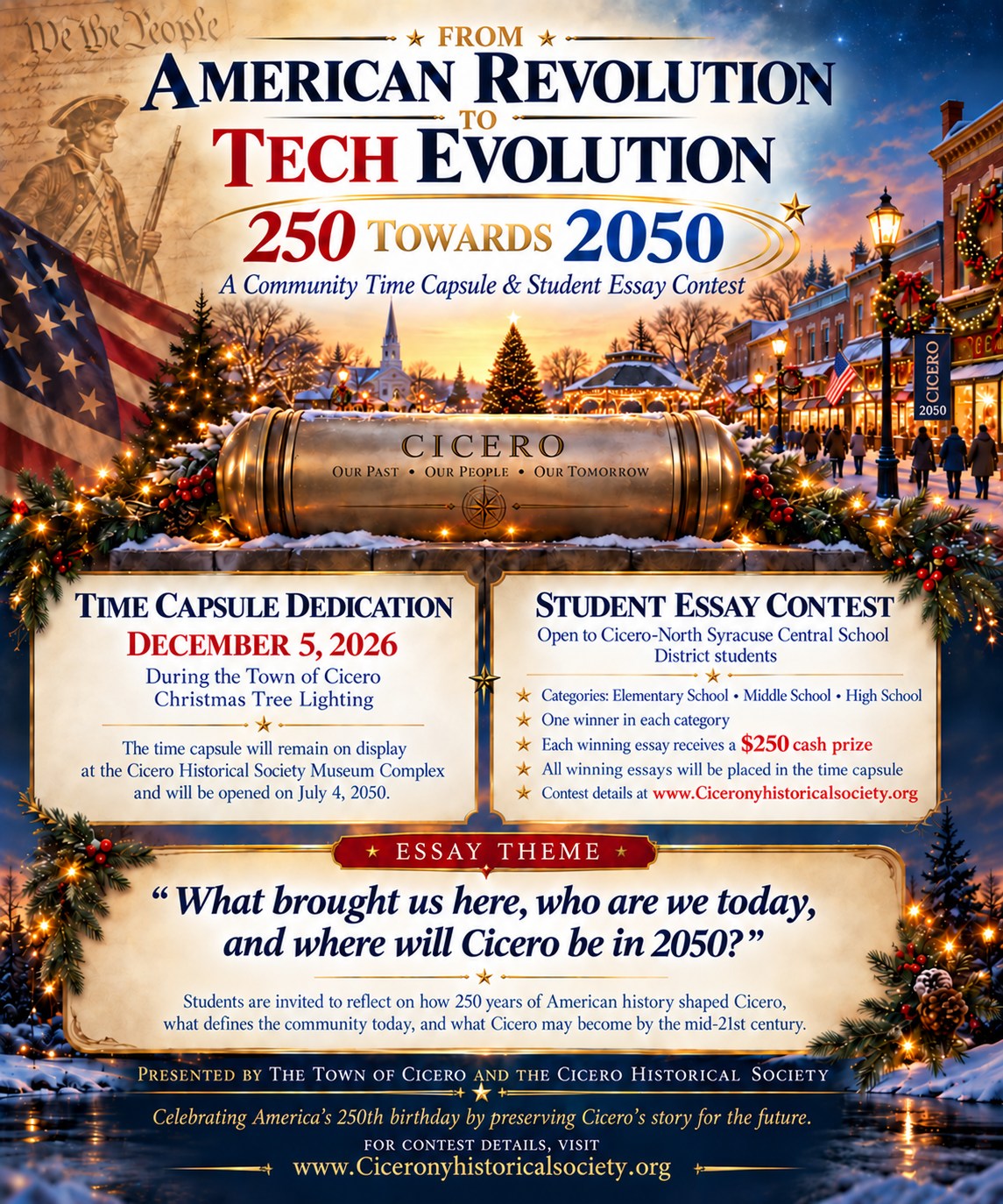 Student Essay Contest$250 prizes · Entries Nov 1–30November 1–30, 2026Learn more →
 Cicero Historical Society